My final-year capstone project is now published in the EdUHK Research Repository. EduBalancer is a culturally-themed self-balancing robot kit I designed for STEM education in Hong Kong secondary schools — it combines robotics hardware assembly, AI-assisted 3D modelling, and a Daruma cultural design to make complex engineering ideas tangible.
Citation: Siu, C. P. (2026). EduBalancer: A Culturally-Themed Self-Balancing Robot Kit for STEM Education — Integrating Robotics, AI 3D Modeling, and Cultural Design for Enhanced Learning Motivation. Bachelor of Education (Honours) in Information and Communication Technology, The Education University of Hong Kong. Programme code A5B057, Course INT4083. Research output: Thesis › Capstone Projects (CP). Publication status: Published, April 2026.
Repository record: EdUHK Research Repository — EduBalancer
Full text (PDF, via EdUHK Library): 202601941_1.pdf
What EduBalancer is
A two-wheeled self-balancing robot is the mechanical equivalent of the inverted pendulum — the canonical problem in control theory. When a student changes a PID parameter and watches the robot wobble, overshoot, or settle, the abstract feedback loop becomes something you can see and feel. That is the core bet of this project.
Three design priorities guided the kit: affordable (target under HKD 500 per kit so a class set of 30 fits a typical school budget), classroom-safe (low-voltage operation, enclosed moving parts), and replicable (open, standardised parts and documentation).
The core hardware (Appendix A of the thesis):
- Microcontroller: Arduino (ATmega328P, 5V) — the ecosystem teachers are most likely to already know
- IMU: MPU6050, 6-axis, I2C
- Motor driver: TB6612FNG, 1.2A per channel, dual motor control
- Motors: 6V geared motors, 200 RPM, with encoders
- Battery: 12V Li-ion, 2200mAh rechargeable
- Chassis + wheels: PLA 3D-printed Daruma shell, 65mm rubber tyres
- Wiring: pre-crimped colour-coded jumpers (red = power, black = ground, yellow = signal) so errors are traceable by colour, not schematics
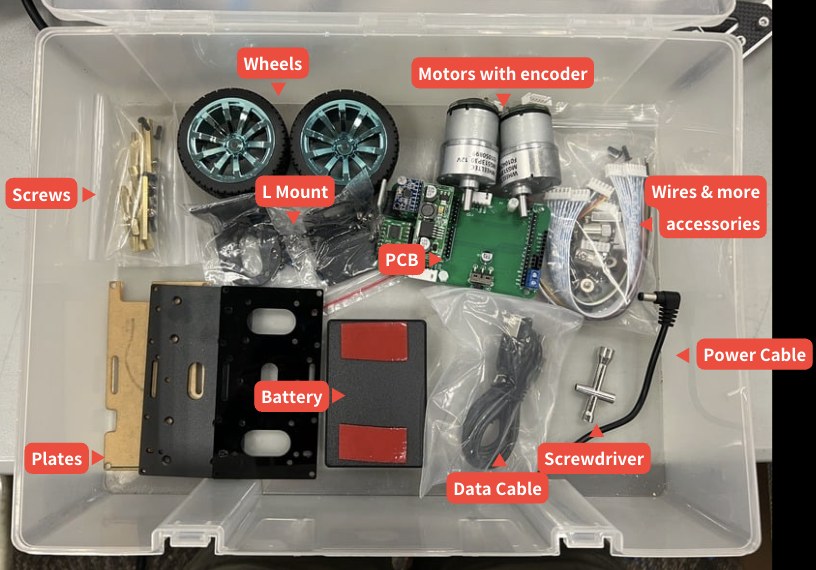
The classroom kit: every part labelled, colour-coded wiring, no soldering required to get started.
Why a Daruma?
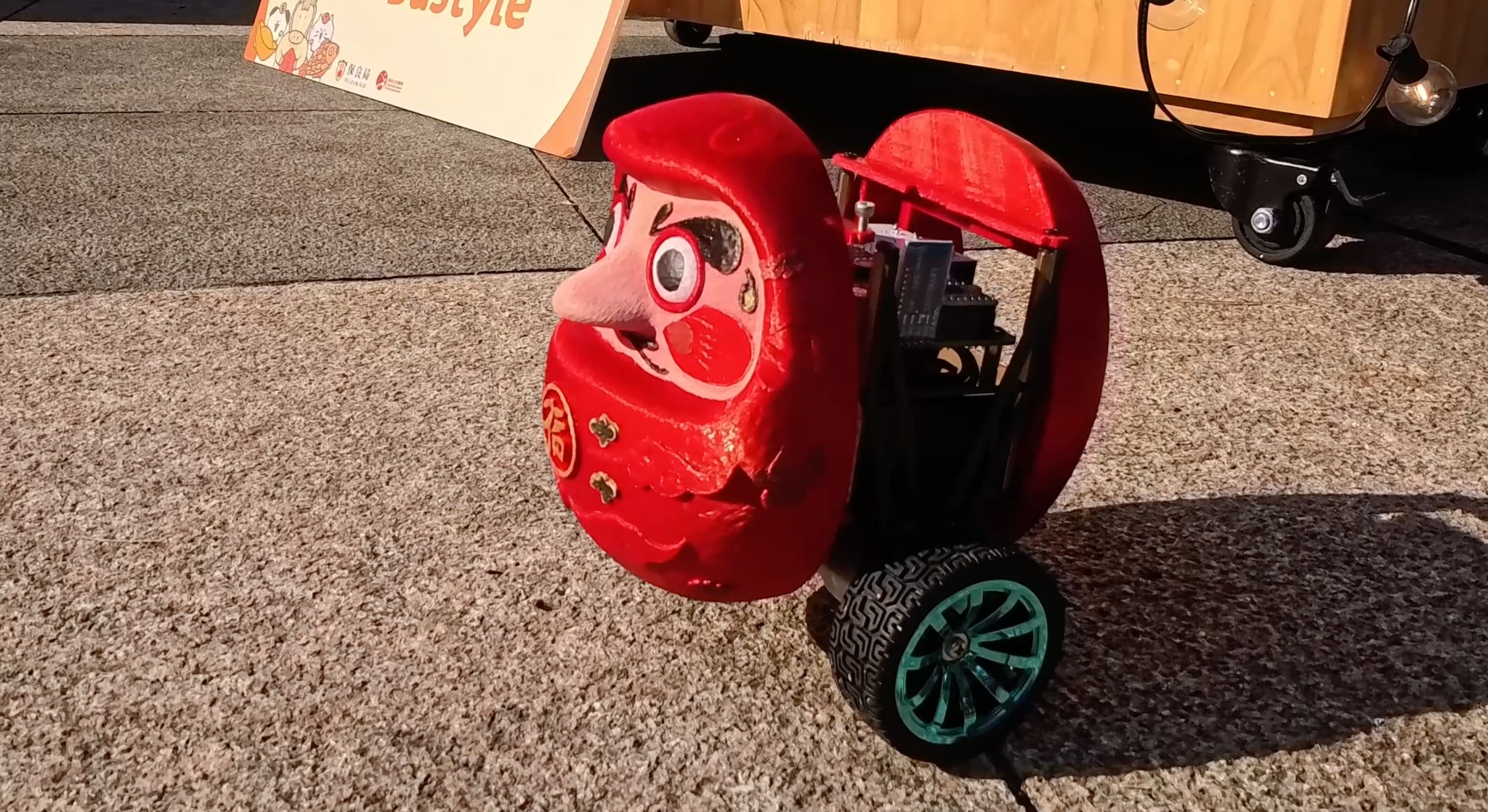
The Daruma theme is not decoration — it is conceptual scaffolding. A Daruma doll rights itself when tipped; the robot tries to do the same thing with sensors and motors. That analogy gives students an intuition for what “balancing” means before they meet the control loop. In Session 2, students design their own Daruma shells with an AI-assisted workflow (prompt → generate → refine → export STL/OBJ), then slice and 3D-print them. The magnetic shell system means personalisation needs no extra technical skill, so every student can take part.
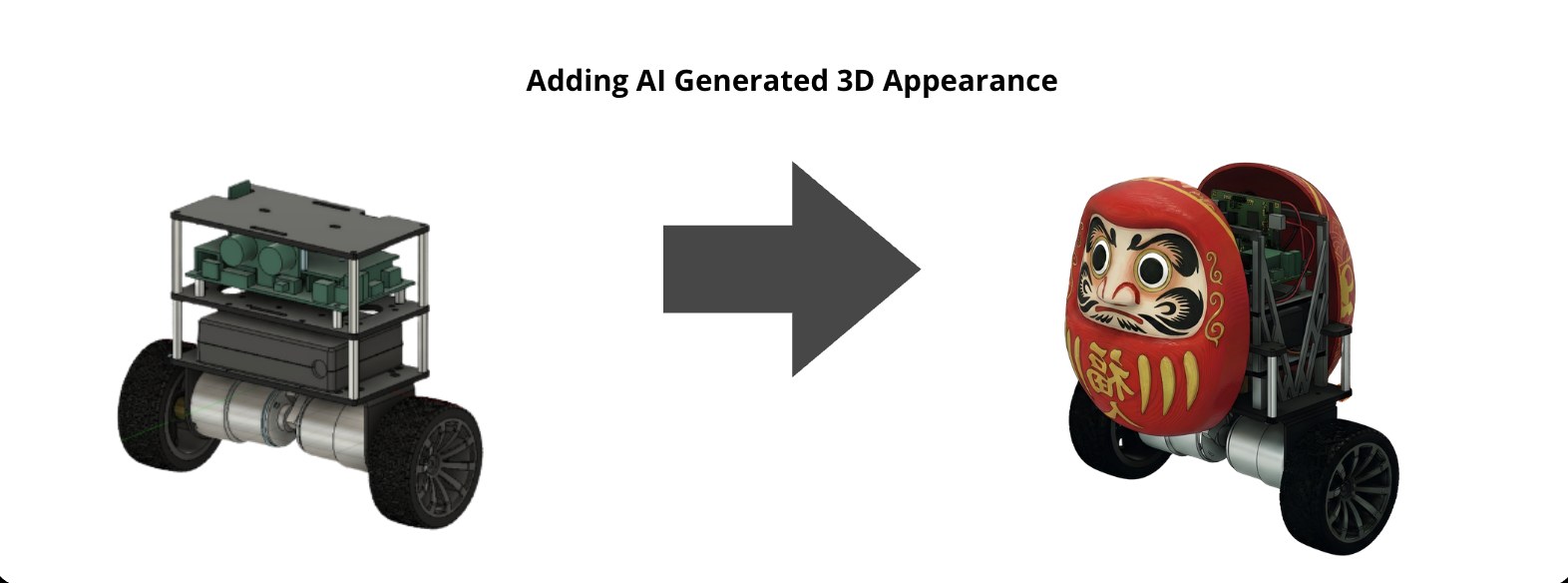
From bare chassis to Daruma: the AI-assisted shell is the Session 2 artefact — same robot, culturally-themed appearance.
How it teaches: 3 × 90 minutes
The intervention fits standard Hong Kong double-period blocks:
- Session 1 — Hardware build & first test: safety and kit inventory, component identification (MCU, IMU, motor driver, motors, battery), step-by-step assembly with peer checking, then power-on and wheel-direction test. Roles rotate: builder / wire-checker / recorder.
- Session 2 — AI 3D modelling + Daruma shell: prompt-to-generate-to-refine onboarding, shell design within fit/clearance/durability constraints, printability check, slicing and print queue, plus a one-minute design share per group.
- Session 3 — PID tuning + performance challenge: the instructor shows what too-high and too-low gains look like, students run at least two logged tuning trials changing one parameter at a time, then a mini-challenge (longest balance / fastest recovery / least wobble) with guided reflection.
What the study found
Mixed-methods design: pre/post questionnaires with 28 secondary students (all novices — no prior robotics experience), plus professional evaluation by 77 in-service and preservice teachers.
- Overall STEM attitude: +18.4% (Mpre = 3.64 → Mpost = 4.31, t(27) = 11.90, p < .001, Cohen’s d = 2.80)
- Knowledge domain: +37.1% — the largest gain, including sensor understanding +51.3%
- Teachers: 88.2% satisfaction, 100% recommendation rate for adoption in other schools
- Top-rated aspects (N = 77): recommendation willingness 4.64/5, student motivation enhancement 4.61/5, safety 4.58/5, clear learning objectives 4.56/5, assembly instructions 4.49/5
One in-service teacher (8 years’ experience) noted the Daruma design “immediately captured students’ attention” and seemed to lower resistance to the technical content. Another noted it was finally “a robotics kit that did not require hours of preparation” — which matters for sustainable classroom use.
Honest limitations
The thesis states these plainly and I repeat them here: n = 28 from a single school limits generalisability, there was no control group, measures were self-reported, and the very large effect size should be read cautiously (homogeneous sample, highly structured format, possible response bias). The next step is larger, more diverse samples with control groups and objective assessments.
What this means for my teaching
EduBalancer is the kit I wish I had when I started teaching robotics: cheap enough to field a class set, safe enough for novices, and structured so a teacher with no robotics background can run it in three double periods. The Daruma shell does double duty — cultural resonance plus a physical intuition for feedback control. If you teach ICT or STEM in Hong Kong and want to try the curriculum, reach out.
— Cloof Siu