Pollen Robotics — the French team behind the open-source Reachy humanoid — released the complete reinforcement-learning stack for their new ~25 cm / ~800 g bipedal robot Microduck: 44+ RL task environments, the whole sim2real recipe, and every policy they run on the real robot. You don’t need the hardware to use it. This post is my own record of installing it on a home PC, driving three of its environments in simulation, and training a new walking policy locally on a 6 GB RTX 2060 — plus the honest numbers and the traps I hit along the way.
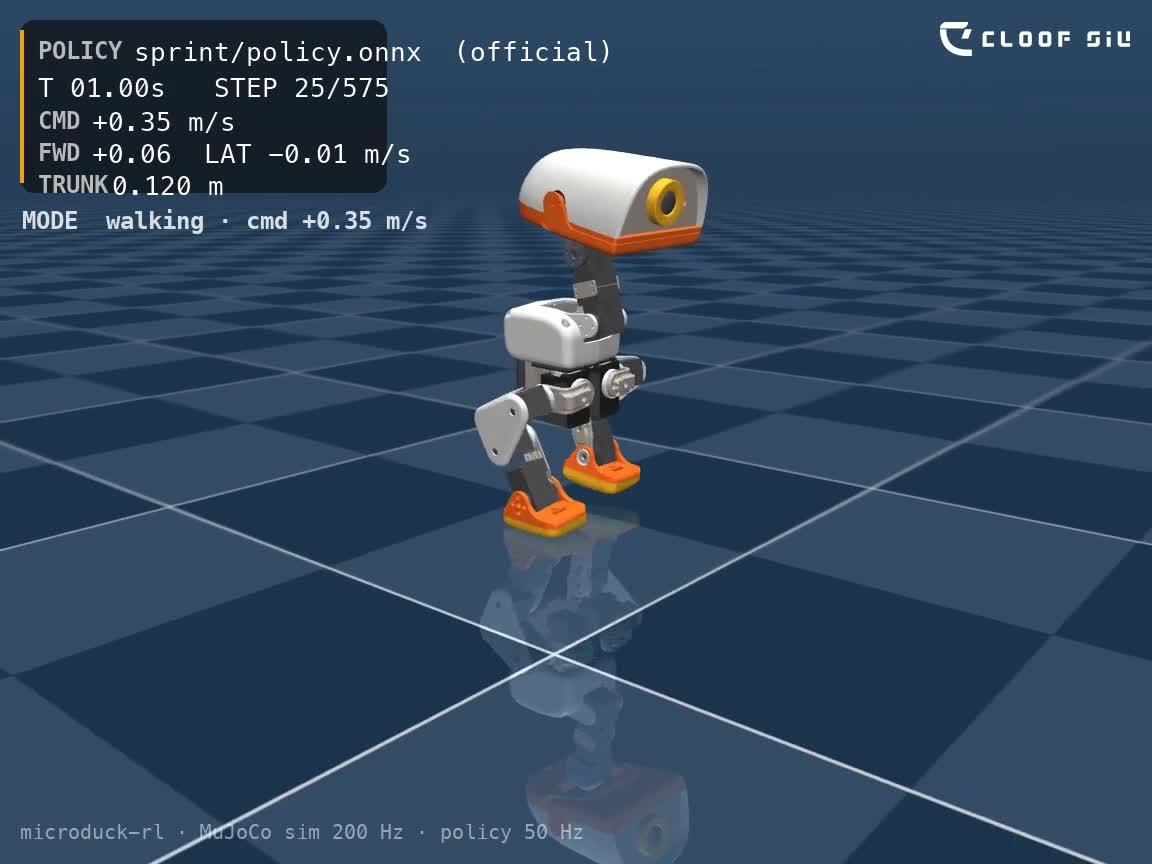
alpha_walking reference policy sprinting on flat ground. Commanded 0.35 m/s, straight line: 5.9 m in 11.5 s.1 · What you need
| Part | Minimum | Notes |
|---|---|---|
| GPU (training) | Any CUDA GPU, ~6 GB VRAM | RTX 2060 6 GB ran 2048 parallel envs at 3.7 GB. 8 GB+ fits 4096 envs (the upstream default). |
| GPU (play only) | None — CPU works | Policy inference and the 3D viewer run fine without CUDA. |
| RAM / disk | 16 GB / ~10 GB free | The first uv sync pulls ~2 GB of CUDA wheels (torch 2.9.1 cu128, MuJoCo Warp). |
| OS | Ubuntu (native or WSL2) | Everything here ran inside WSL2 on Windows 11 with the NVIDIA WSL driver. |
2 · Install (15 minutes)
Three commands. uv is the Python package manager the project uses; the long HTTP timeout matters because the first sync downloads ~2 GB of pinned CUDA wheels.
curl -LsSf https://astral.sh/uv/install.sh | sh
git clone https://github.com/pollen-robotics/microduck_rl
cd microduck_rl
export UV_HTTP_TIMEOUT=600
uv sync          # ~2 GB first run, < 10 min on fibre
uv run list-envs # the gym registry — 44 tasks
list-envs is the full task table: walking, stand-up, sit/stand, ground-pick, ball kick, forward roll (roulade), roller skating (six roller tasks), all with Backlash variants that add realistic gear-play to every servo. Every one is a self-contained PPO gym.
nvidia-smi inside WSL before training. My card showed up as NVIDIA GeForce RTX 2060, 6144 MiB and uv run python -c "import torch; print(torch.cuda.is_available())" → True.3 · Load the policies the real robot runs
Pollen publishes everything the physical Microduck runs to a Hugging Face model card — eleven ONNX files, ~800 KB each. You download the exact networks that live inside the robot and drive them in the simulator.
uv run python - <<'EOF'
from huggingface_hub import snapshot_download
snapshot_download(repo_id="pollen-robotics/microduck-policies",
                  local_dir="/home/<you>/microduck_policies")
EOF
4 · Drive a policy with the keyboard
The repo's scripts/infer_policy.py loads the scene, swaps in the ONNX policy and steps MuJoCo at 50 Hz in a normal desktop viewer — the same actuator model, control rate and observation contract as the physical robot:
uv run scripts/infer_policy.py
  --walking ~/microduck_policies/velstand.onnx
--new-cmd-obs| Key | Action |
|---|---|
| ↑ / ↓ | forward speed +/− (max 0.3 m/s) |
| ← / → | strafe (velstand tracks lateral commands) |
| A / E | turn rate ±1.5 rad/s |
| SPACE | zero command — the same policy stands |
| P | shove the trunk 1.0 m/s in a random direction (the training curriculum's hardest push) |
| K / L / R | trigger kick-left / kick-right / roulade (with those ONNX loaded) |
| Q | quit |
The official ball-kick scene is loaded automatically when you pass --kick-left / --kick-right (it needs --new-cmd-obs too) — that is exactly demo ③.
5 · How I recorded the three videos (headless, no GUI)
The videos above are straight MuJoCo renders of the same loop — I wrote a ~180-line script that reuses the repo's own PolicyInference class, runs the identical physics steps (4 sub-steps per control tick, BAM voltage actuator), screens offscreen with MuJoCo's EGL backend, and pipes frames straight into ffmpeg:
MUJOCO_GL=egl uv run python cloof_demo.py --demo walk    # / recovery / kick
# 1152x864, 25 fps, every 2nd control frame, libx264 CRF21MUJOCO_GL=egl plus model.vis.global_.offwidth / offheight raised from the 640×480 default, and scene.flags[mjRND_SHADOW] = 0 to kill the strip-artefact shadows. I've kept the script; a cleaned-up version you can drop into scripts/ is at the bottom of this post.6 · Train your own walking policy on a 6 GB card
One command starts PPO on 2048 parallel ducks:
uv run train Mjlab-Velocity-Flat-MicroDuck
  --env.scene.num-envs 2048
  --agent.logger tensorboard
  --agent.max-iterations 2000
  --agent.run-name cloof_local_2048
Real numbers from my RTX 2060:
| Setting | Value |
|---|---|
| 1024-envs probe | 3.0 s/iter · 1.25 GB VRAM |
| 2048-envs run (final) | 3.5–3.7 s/iter · 3.7 GB / 6.1 GB VRAM · GPU util ~49% |
| 2000 iterations | 2 h01m total (98,304,000 simulator steps) |
| Checkpoints | logs/rsl_rl/<run>/model_NNNN.pt (writing continues while training; safe to Ctrl-C and resume with --agent.load-checkpoint) |
--agent.logger tensorboard: the default logger is wandb and would want an account/API key. TensorBoard leaves everything on disk — run uv run tensorboard --logdir logs/rsl_rl to watch the reward climb live.Export the winner (the exporter bakes the observation normalizer into the ONNX graph — this is the one path to a deployable file):
uv run scripts/export.py Mjlab-Velocity-Flat-MicroDuck
  --checkpoint-file logs/rsl_rl/<yours>/model_1999.pt
# then drive it exactly like the official ones:
uv run scripts/infer_policy.py
  --walking my_new_walk.onnx --new-cmd-obs --lin-vel-x 0.22
The fourth video above is my model from this run — same inference loop as the official policies.
7 · What the numbers taught me
- My 2-hour local PPO run: stable but conservative. The final checkpoint never fell in any probe run, tracked ~0.13 m/s at a 0.30 command and ~0.28 m/s at 0.50 (~56% tracking), and even has a dead zone — below ~0.25 command it just stands there. The official sprint reference still walks faster (0.53 m/s), but with 98 M simulation steps of my own on a consumer 6 GB card, "trained it overnight" here took one relaxed evening.
- The shipped "walk" policy is deliberately lazy.
velstand.onnx(the default robot brain, trained on rough terrain + backlash) under-tracks linear commands in the quiet flat scene: commanded 0.22 m/s → achieved ~0.07 m/s. I reproduced the same ratio with the official inference loop, so it isn't my wiring: robustness was traded for tracking. It still turns and recovers beautifully. - Use the reference sprint policy when you need speed. Pollen publishes reference policies separately (e.g. microduck-sprint-2m) — the sprint reference hit 0.53 m/s at a 0.35 m/s command (it overshoots; it was trained for a 2 m sprint) and walks a clean straight line, but falls if you stack a hard turn on it.
- Fall recovery is the hero trick. VelStand's v8 update trains getting up from a fall inside the walking policy — in my clip the duck goes from lying-on-its-side to standing in about 1 s after a 1.15 m/s shove.
- Everything is ONNX-first. Policies train on GPU (MuJoCo Warp) then export to a 61→14-dim ONNX — the same file runs in the simulator, on the real robot, and anywhere ONNX Runtime runs. That's why "download official→run locally" works with zero glue code.
8 · Ideas from here
- Warm-start my local model from a Pollen checkpoint and fine-tune on flat + a tiny reward nudge — a "policy remix" that then deploys on the real robot if you own one.
- Run the rough-terrain and slope tasks; the environment code randomly re-rolls terrain every reset.
- Classroom angle: the same 61→14 contract that swaps walk→recover→kick behind one button on the real robot is a lovely concrete example of model switching for AI students.
- The roller-skating family (six tasks!) trains a duck on passive wheels under its feet — the funnest demo material, next on my list.
Credits & licenses
- Repo: pollen-robotics/microduck_rl (Apache 2.0). Projects home: pollen-robotics/microduck. Policies: pollen-robotics/microduck-policies.
- Training stack: mjlab (MuJoCo Warp + PPO) and the BAM actuator models from Rhoban.
- The 3D model files are CC BY-NC-SA — non-commercial use only for the meshes; code above is Apache 2.0.
- All videos in this post were rendered from my own simulation runs at home. © 2026 Cloof Siu.
Bonus · the full headless render script
cloof_demo.py — click to unfold (paste into the repo's scripts/ directory)
#!/usr/bin/env python3
"""Headless demo-video recorder for microduck_rl (Cloof tooling).

Runs the official ONNX policies through the SAME loop as
scripts/infer_policy.py (BAM actuators, 50 Hz control, decimation 4),
renders offscreen with MuJoCo EGL, and pipes frames into ffmpeg.

Demos:
  walk      velstand protocol: stand -> forward -> strafe -> turn -> forward
  recovery  velstand: get pushed 1 m/s (curriculum cap) and recover
  kick      scene_ball.xml: kick left, then kick right
"""
import argparse
import json
import math
import os
import subprocess
import sys

os.environ.setdefault("MUJOCO_GL", "egl")

import numpy as np  # noqa: E402

REPO = "/home/cloofsiu/microduck_rl"
POLICIES = "/home/cloofsiu/microduck_policies"
sys.path.insert(0, os.path.join(REPO, "scripts"))
import infer_policy as ip  # noqa: E402
import mujoco  # noqa: E402

DEMO_DATA = {
    "walk": {
        "scene": ip.MICRODUCK_XML,
        "sessions": {"walking_onnx_path": f"{POLICIES}/../microduck_sprint/policy.onnx"
                     if os.path.exists(f"{POLICIES}/../microduck_sprint/policy.onnx")
                     else f"{POLICIES}/velstand.onnx"},
        "plan": [
            (0.5, "vel", (0.35, 0.0, 0.0)),
            (9.8, "vel", (0.0, 0.0, 0.0)),
        ],
        "seconds": 11.5,
    },
    "local": {
        "scene": f"{REPO}/src/mjlab_microduck/robot/microduck/scene_walk.xml",
        "sessions": {"walking_onnx_path": f"{REPO}/output.onnx"},
        "plan": [
            (0.5, "vel", (0.30, 0.0, 0.0)),
            (9.8, "vel", (0.0, 0.0, 0.0)),
        ],
        "seconds": 11.5,
    },
    "recovery": {
        "scene": ip.MICRODUCK_XML,
        "sessions": {"walking_onnx_path": f"{POLICIES}/velstand.onnx"},
        "plan": [
            (1.5, "push", (1.15, math.radians(105))),
            (7.5, "vel", (0.35, 0.0, 0.0)),
            (9.8, "vel", (0.0, 0.0, 0.0)),
        ],
        "seconds": 10.5,
        "push": 1.15,
    },
    "kick": {
        "scene": ip.MICRODUCK_BALL_XML,
        "sessions": {
            "walking_onnx_path": f"{POLICIES}/velstand.onnx",
            "kick_left_onnx_path": f"{POLICIES}/ball_kick_left.onnx",
            "kick_right_onnx_path": f"{POLICIES}/ball_kick_right.onnx",
            "kick_duration": 3.0,
        },
        "plan": [
            (1.2, "kick", "kick_left"),
            (4.5, "kick", "kick_right"),
        ],
        "seconds": 7.5,
    },
}


def trunk_addresses(model):
    jid = mujoco.mj_name2id(model, mujoco.mjtObj.mjOBJ_JOINT, "trunk_base_freejoint")
    return int(model.jnt_qposadr[jid]), int(model.jnt_dofadr[jid])


def build(spec, action_scale=1.0, width=1152, height=864):
    bam_model = ip.load_bam_model(ip.BAM_KP_FW, 7.4, ip.BAM_MAX_CURRENT)
    model, data, bam_ctrl, _names = ip.load_mujoco_with_bam(
        spec["scene"], bam_model, 0.005, None, ip.BAM_VIN_MIN)
    model.vis.global_.offwidth = max(width, 640)
    model.vis.global_.offheight = max(height, 480)
    policy = ip.PolicyInference(
        model, data, bam_ctrl=bam_ctrl, action_scale=action_scale,
        use_projected_gravity=True, new_cmd_obs=True,
        **spec["sessions"])
    qpos_adr, qvel_adr = trunk_addresses(model)
    data.qpos[qpos_adr:qpos_adr + 2] = 0.0
    data.qpos[qpos_adr + 2] = 0.125
    data.qpos[qpos_adr + 3:qpos_adr + 7] = [1, 0, 0, 0]
    for i, idx in enumerate(policy.joint_qpos_indices):
        data.qpos[idx] = policy.default_pose[i]
    if spec["scene"] == ip.MICRODUCK_BALL_XML:
        bj = mujoco.mj_name2id(model, mujoco.mjtObj.mjOBJ_JOINT, "ball_free")
        bqa = int(model.jnt_qposadr[bj])
        data.qpos[bqa:bqa + 3] = [-0.5, 0.35, 0.035]
        data.qpos[bqa + 3:bqa + 7] = [1, 0, 0, 0]
    bam_ctrl.reset(data.qpos)
    policy.set_position_targets(policy.default_pose)
    mujoco.mj_forward(model, data)
    policy.vel_max_x, policy.vel_min_x = 0.3, -0.3
    policy.vel_max_y, policy.vel_min_y = 0.2, -0.2
    policy.vel_max_ang = 1.5
    return model, data, bam_ctrl, policy, qpos_adr, qvel_adr


def plan_op(plan, t):
    for (pt, kind, args) in plan:
        if abs(t - pt) < 0.01:
            return kind, args
    return None, None


def run(demo, out_dir, width, height, fps_div, push_mag=None):
    spec = dict(DEMO_DATA[demo])
    if push_mag is not None:
        spec["plan"] = [(t, k, (push_mag, a) if k == "push" else v)
                        for (t, k, v) in spec["plan"]]
    model, data, bam_ctrl, policy, qpos_adr, qvel_adr = build(spec, width=width, height=height)
    os.makedirs(out_dir, exist_ok=True)
    mp4 = os.path.join(out_dir, f"duck_{demo}.mp4")

    from mujoco import Renderer
    metrics = {"demo": demo, "steps": 0, "control_dt": 0.02,
               "vel_avg": [], "frames": 0}
    renderer = None
    ffmpeg = None
    try:
        renderer = Renderer(model, height=height, width=width)
        cam = mujoco.MjvCamera()
        cam.azimuth = 130
        cam.elevation = -14
        cam.distance = 0.78

        ffmpeg = subprocess.Popen([
            "ffmpeg", "-y", "-loglevel", "error",
            "-f", "rawvideo", "-pix_fmt", "rgb24",
            "-s", f"{width}x{height}", "-r", "25", "-i", "pipe:",
            "-c:v", "libx264", "-preset", "medium", "-crf", "21",
            "-pix_fmt", "yuv420p", "-movflags", "+faststart", mp4,
        ], stdin=subprocess.PIPE)

        decim = 4
        control_dt = decim * model.opt.timestep
        n_steps = int(spec["seconds"] / control_dt)
        metrics["steps"] = n_steps
        metrics["control_dt"] = control_dt
        frame_every = max(1, fps_div)
        vel_hist = []
        start_pos = None
        for step in range(n_steps):
            t = step * control_dt
            kind, args = plan_op(spec["plan"], t)
            if kind == "vel":
                policy.set_vel_cmd(*args)
                print(f"[{t:5.1f}s] cmd -> {args}", flush=True)
            elif kind == "push":
                mag, ang = args
                data.qvel[qvel_adr + 0] = mag * math.cos(ang)
                data.qvel[qvel_adr + 1] = mag * math.sin(ang)
                print(f"[{t:5.1f}s] PUSH {mag:.2f} m/s @ {math.degrees(ang):.0f} deg", flush=True)
            elif kind == "kick":
                policy.trigger_behavior(args)
                print(f"[{t:5.1f}s] trigger {args}", flush=True)

            policy.update_ground_pick_phase(control_dt)
            policy.update_behavior(control_dt)
            action = policy.infer()
            policy.apply_action(action)
            for _ in range(decim):
                bam_ctrl.update()
                mujoco.mj_step(model, data)

            quat = data.qpos[qpos_adr + 3:qpos_adr + 7].astype("float32")
            v_w = data.qvel[qvel_adr:qvel_adr + 3].astype("float32")
            v_b = policy.quat_rotate_inverse(quat, v_w)
            vel_hist.append((float(v_b[0]), float(v_b[1]), float(t)))
            if len(vel_hist) > 50:
                vel_hist.pop(0)
            if step % 50 == 0:
                avg = tuple(float(sum(v[i] for v in vel_hist) / len(vel_hist)) for i in (0, 1))
                metrics["vel_avg"].append({"t": round(float(t), 2), "fwd": round(avg[0], 3),
                                           "lat": round(avg[1], 3),
                                           "cmd": [float(policy.vel_cmd[0]), float(policy.vel_cmd[1])],
                                           "trunk_z": round(float(data.qpos[qpos_adr + 2]), 4),
                                           "policy": policy.current_policy})
            if start_pos is None:
                start_pos = np.array(data.qpos[qpos_adr:qpos_adr + 2])
            if step % frame_every == 0:
                p = data.qpos[qpos_adr:qpos_adr + 3]
                cam.lookat[:] = [p[0], p[1], max(0.02, float(p[2]) * 0.55)]
                renderer.update_scene(data, camera=cam)
                renderer.scene.flags[mujoco.mjtRndFlag.mjRND_SHADOW] = 0
                img = renderer.render()
                ffmpeg.stdin.write(img.tobytes())
                metrics["frames"] += 1
        ffmpeg.stdin.close()
        ffmpeg.wait()
        metrics["travelled_m"] = round(float(np.abs(data.qpos[qpos_adr:qpos_adr + 2] - start_pos).sum()), 3)
        with open(os.path.join(out_dir, f"duck_{demo}_metrics.json"), "w") as f:
            json.dump(metrics, f, indent=2)
    finally:
        if renderer is not None:
            try:
                renderer.close()
            except Exception as exc:
                print(f"renderer close warning: {exc}", flush=True)
        if ffmpeg is not None and ffmpeg.stdin is not None and not ffmpeg.stdin.closed:
            ffmpeg.stdin.close()
            ffmpeg.wait(timeout=60)
    print(f"DONE {mp4}  travelled={metrics.get('travelled_m')}", flush=True)


def main():
    ap = argparse.ArgumentParser()
    ap.add_argument("--demo", required=True, choices=list(DEMO_DATA))
    ap.add_argument("--out", required=True)
    ap.add_argument("--width", type=int, default=1152)
    ap.add_argument("--height", type=int, default=864)
    ap.add_argument("--fps-div", type=int, default=2)
    ap.add_argument("--push", type=float, default=None)
    a = ap.parse_args()
    run(a.demo, a.out, a.width, a.height, a.fps_div, a.push)


if __name__ == "__main__":
    main()