
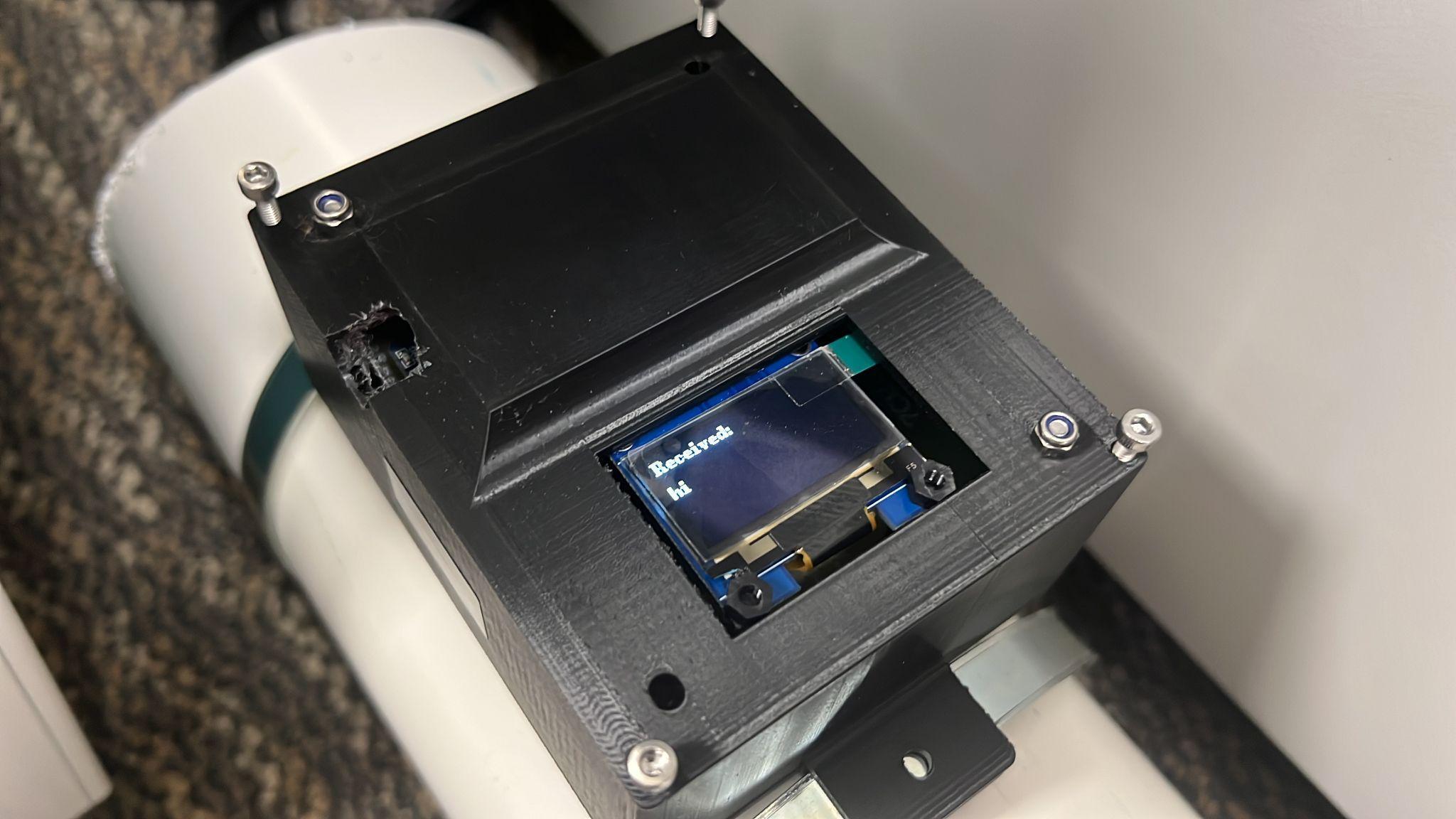
Most of us have never thought about it, but there are places where your phone simply becomes a brick: inside manholes, basements, service tunnels and reinforced-concrete utility chambers. Radio signals (LMRS, LTE, LoRa) are heavily attenuated and screened by soil, concrete and rebar. In confined-space accidents, more than 60% of historical fatalities were the rescuers themselves — a missing communication channel can cost lives on both sides of the wall.
SonoResQ is my answer to that gap: a battery-operated, infrastructure-free emergency communication system that turns ordinary building pipes into acoustic data waveguides. When RF is physically blocked, a worker presses one button and a short SOS packet — node ID and TTL included — travels through the pipe network itself toward a listening receiver at the surface.
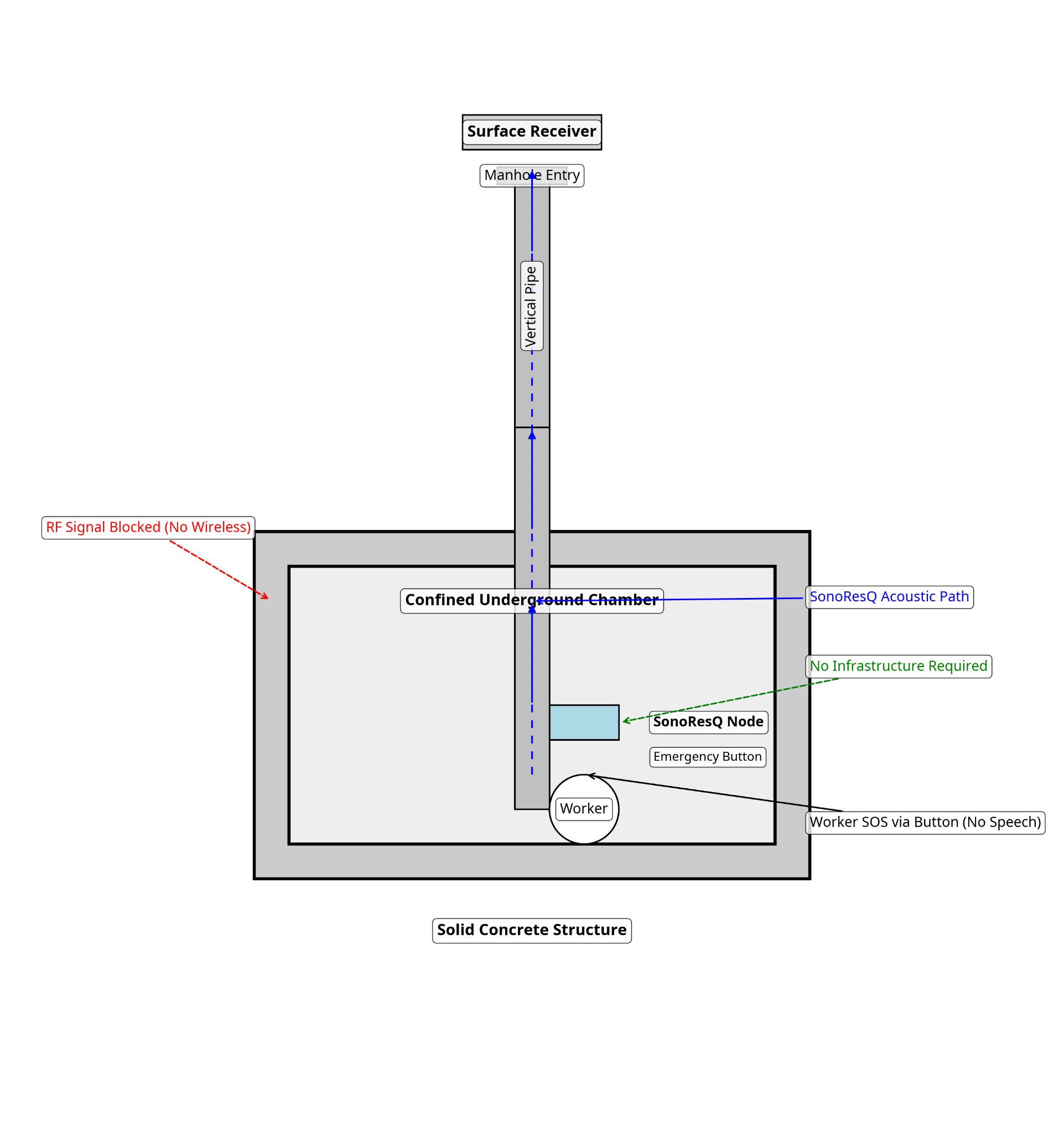
The usage scenario: an RF-blocked underground chamber, a one-button SOS node clamped to the pipe, and the guided acoustic path to the surface receiver.
How it works
The design leans on three ideas:
- Pipes are already the infrastructure. uPVC / HDPE pipework carries low-kHz sound with far less attenuation than open air — the duct becomes the channel, so no new cabling or network build-out is needed.
- Data-over-sound, not bandwidth. The payload is deliberately tiny: 16 fixed bytes carrying an emergency flag, a node identifier and a TTL. Modulation uses ggwave (multi-frequency FSK with Reed–Solomon error correction), configured as MT Fastest with direct-sequence spreading (DSS) — the robust end of the trade-off, not the fast end.
- Asymmetric compute saves batteries underground. Underground nodes stay simple and frugal (tone generation, basic decoding); the surface receiver (Raspberry Pi Zero 2W) handles continuous listening, signal processing and error-correction decoding.
Between nodes, a repeater listens, decodes, guards for about 200 ms against self-echo, then re-transmits — with a TTL counter and a message-ID cache so the network relays hop-by-hop without ever flooding back on itself.
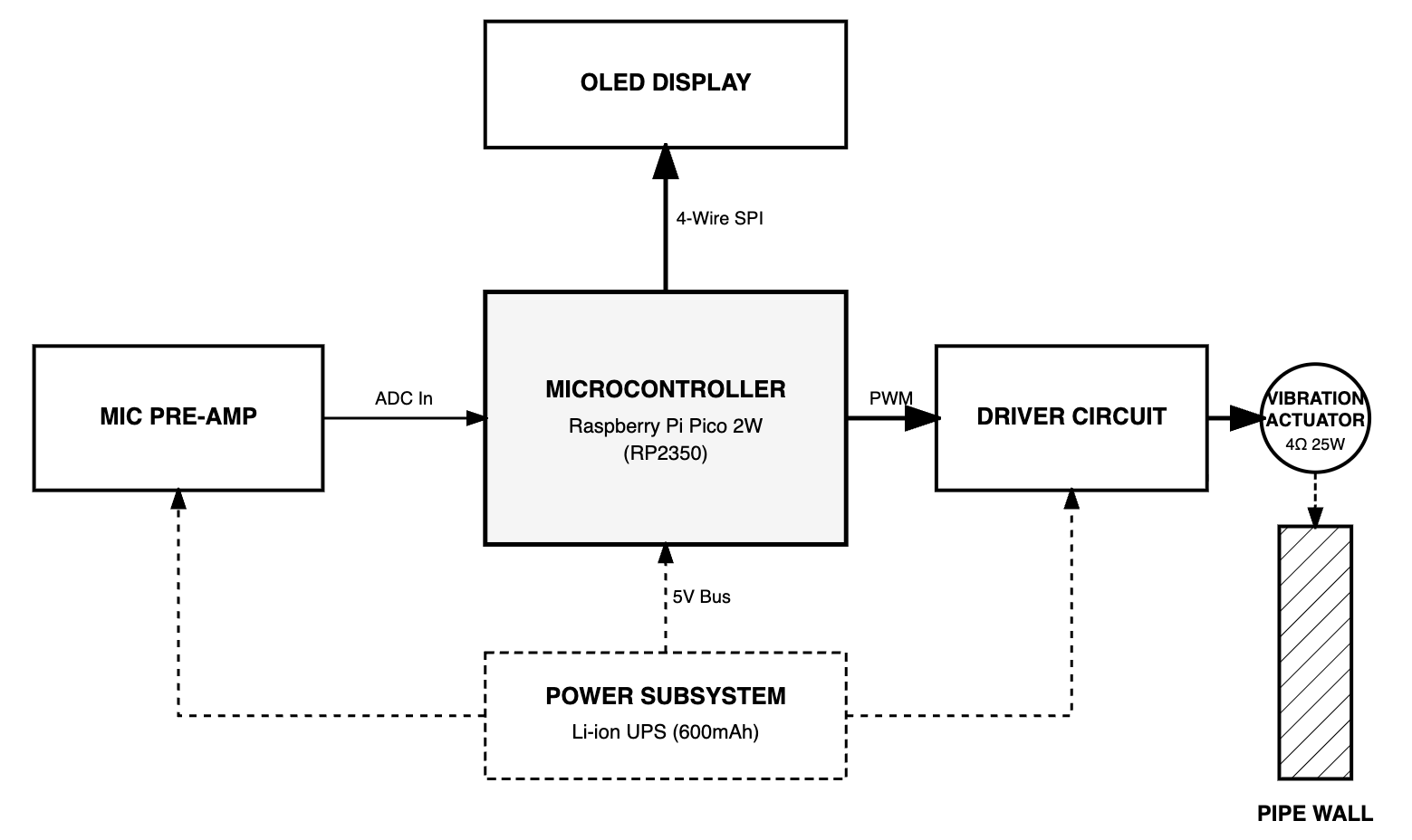
Repeater node architecture: RP2350 + MAX9814 AGC preamp (48 kHz DMA capture) driving a clamped 4-ohm/25 W vibration actuator into the pipe wall.
What the experiments showed
I validated the system on a modular uPVC rig (DN150–300, air-filled): 2 m and 4 m straight runs, plus an 8 m path with a 45° elbow (non-line-of-sight). Each condition ran at least 50 transmission trials.
- PDR ≥ 95% across all configurations, including the 8 m NLOS path through the elbow.
- Decoded packets held SNR > 10 dB; after threshold calibration, zero false positives in 30 minutes of idle listening.
- The vibration actuator coupled into the pipe wall far more efficiently than a free-air speaker at equal electrical input — the next-generation transmitter averages under 10 mW per alert sequence, and each prototype node costs under HK$500.
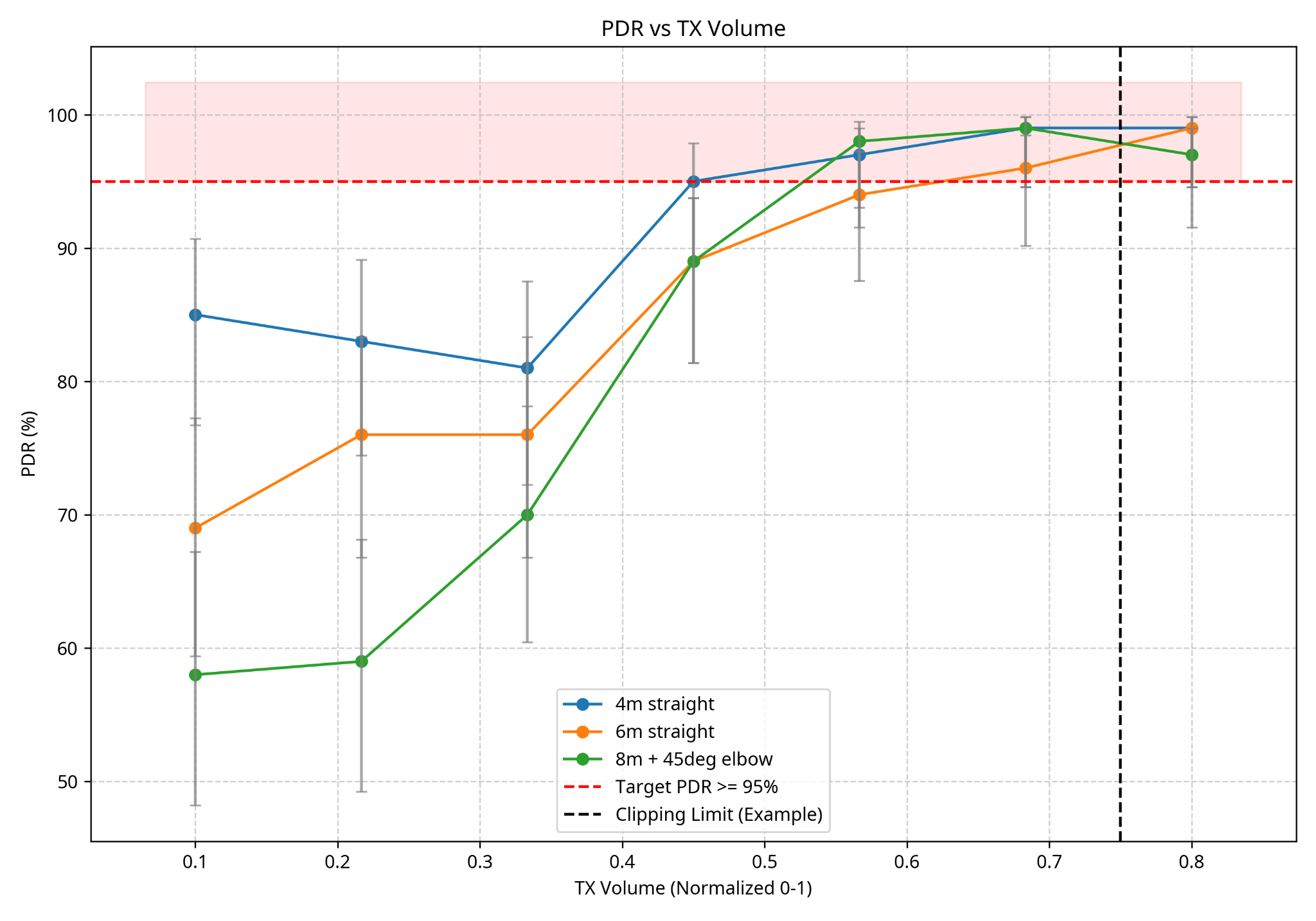
PDR vs transmit volume: a clear operating region appears once coupling is sufficient — beyond it, delivery is close to deterministic (each point: ≥50 trials across the three pipe configurations).
For contrast, the same link in open air managed only about 4–10 m depending on ambient noise. The pipe does the heavy lifting.
What I learned building it
The final hardware grew out of a year of failed iterations, and the process mattered as much as the result: ESP32 + MAX9814 was audibly detectable but never reliably decodable within realistic sampling budgets, so the platform pivoted to RP2040/RP2350 with DMA capture; protocol settings hardened to fixed-length payloads, DSS and MT modes following the ggwave documentation; and repeater discipline (TTL + ID cache + guard intervals + cooldown) turned out to matter as much as the physical layer itself.
Credits
Firmware for the underground nodes stays private for now — researchers and educators are welcome to reach out for implementation details.
SonoResQ started as a personal weekend obsession in late 2024 and grew into a full research project. The technical paper was prepared with Dr. Steve W.Y. Mung (The Education University of Hong Kong). Thanks as well to the open-source ggwave community.
— Cloof Siu